Frost Town’s Past Beneath James Bute Park Shows How Downtown Growth Erased Early Houston Homes
A neighborhood that predates modern downtown
On the eastern edge of downtown, a small park along Buffalo Bayou sits atop what historians and archaeologists have identified as one of Houston’s earliest, long-lived residential districts: Frost Town. The community formed in the 1830s near the city’s original port area and remained occupied, in changing waves, for well over a century. Today, the site is largely associated with James Bute Park, where only limited on-site markers indicate the former neighborhood’s footprint.
Who lived there, and why the area mattered
Frost Town developed in close proximity to waterfront commerce, rail activity and industrial work that expanded along the bayou. Over time, the neighborhood became home to multiple working-class communities. Records tied to the area and later archaeological findings describe successive periods of settlement that included European immigrants in the 19th century, African American residents in the post-emancipation era, and Mexican American families who arrived in the early 20th century, when migration increased as turmoil in Mexico reshaped cross-border movement.
Its location—valuable for transportation access—also made it vulnerable as Houston’s infrastructure network expanded. Large-scale roadway and bridge projects in the mid-to-late 20th century progressively altered the landscape and contributed to displacement, leaving little visible evidence of the residential streets that once existed there.
Infrastructure projects triggered major archaeological work
Frost Town reemerged in public view through transportation construction requirements that mandated cultural-resource review before major ground disturbance. Surveys and testing associated with the Elysian Viaduct corridor were conducted across multiple years, followed by large-scale excavations during the summers of 2016 and 2018 as bridge replacement plans advanced.
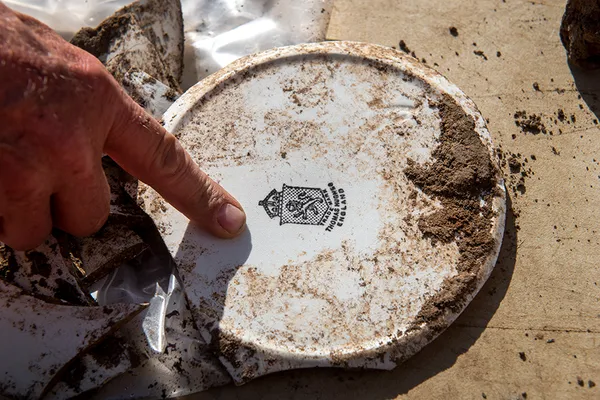
The scale of what was recovered was unusual for a site in the urban core. Fieldwork documented more than 1,400 residential and nonresidential features and recovered more than 250,000 artifacts. Materials included household goods and tools, items associated with children and leisure, and everyday refuse that helps reconstruct routines that rarely appear in official documents.
What the artifacts can—and cannot—answer
Archaeologists emphasize that artifact-rich deposits provide an avenue to study daily life across class and culture, particularly for residents whose experiences were not consistently captured in written archives. The mix of features—such as foundations, cisterns, walkways and yard-related deposits—also indicates that portions of the neighborhood survived below ground even after surface structures were removed.
At the same time, excavation is not the same as full preservation. Construction timelines, right-of-way limits and prior disturbances constrain what can be studied and what remains in place. Some recovered materials are curated for long-term research, while the ground surface above the former neighborhood continues to function as modern park and transportation space.
Key facts at a glance
- Frost Town formed in the 1830s near Buffalo Bayou and persisted for generations as a working-class neighborhood.
- Successive transportation and roadway projects contributed to the area’s physical erasure above ground.
- Multi-year archaeological investigations in the Elysian Viaduct corridor documented more than 1,400 features and recovered more than 250,000 artifacts.
- Findings are used to reconstruct everyday life in early and later Houston, even where buildings no longer stand.
In downtown Houston, Frost Town illustrates how infrastructure building can simultaneously drive growth and remove entire residential landscapes from view—leaving archaeology to recover what streetscapes no longer reveal.